Best Dictation Software for Mac in 2026: 6 Tools Compared
Compare six Mac dictation tools by workflow, privacy, app coverage, and pricing model—without invented accuracy scores or confusing transcription with dictation.
- By TypeBoost
The best dictation software for your Mac depends on what should happen after you speak. Apple Dictation is the simplest free option for text entry. TypeBoost and Wispr Flow are designed to turn rough speech into polished writing across apps. Superwhisper emphasizes configurable live dictation with local processing options. MacWhisper is strongest when recorded audio and file transcription matter too. Apple Voice Control is the right category when you need to operate the Mac hands-free—not just enter text.
That distinction matters more than a generic accuracy claim. A tool can recognize every word and still create extra work if the result lands in the wrong place, needs extensive cleanup, or sends sensitive audio somewhere you did not expect.
The quick comparison
| Tool | Best for | Where it works | Processing model | Pricing model |
|---|---|---|---|---|
| Apple Dictation | Quick, no-cost text entry | Anywhere macOS accepts text | Varies by Mac, language, region, and setting | Included with macOS |
| TypeBoost | Speaking rough ideas, then shaping them with a reusable prompt | Mac writing workflows | Voice transcription plus AI processing | Free and paid plans |
| Wispr Flow | Polished cross-app dictation with a cloud workflow | Mac and other supported platforms | Cloud transcription | Free and paid subscription plans |
| Superwhisper | Configurable dictation, including on-device model options | Mac and other supported platforms | Local or cloud, depending on configuration | Free and paid plans |
| MacWhisper | Private local file transcription plus optional system-wide dictation | Mac | Local models for core transcription; optional cloud features | Free version and paid license options |
| Apple Voice Control | Dictation plus full hands-free Mac navigation | Across macOS | Built-in accessibility system | Included with macOS |
Features and plan structures were checked against official product documentation on August 20, 2026. Pricing changes frequently, so this guide compares pricing models instead of treating a point-in-time dollar amount as permanent.
Dictation, transcription, and Voice Control are different jobs
Live dictation listens through your microphone and puts words into the text field where you are working. It is best for messages, documents, notes, and prompts.
Audio transcription turns an existing recording into a transcript. It needs file support, playback, timestamps, speaker handling, and exports—features that a lightweight dictation tool may not have.
Hands-free control lets you open apps, click controls, navigate, and edit with spoken commands. Apple Voice Control does this. Standard dictation does not.
Meeting notetakers form another category. They capture conversations and produce notes after a call, but they are not necessarily good tools for composing an email at the cursor.

How we compared these Mac dictation tools
We looked for six things that change the daily experience:
- Destination: Does the text appear at the cursor, in a floating result, on the clipboard, or in a transcript library?
- Cleanup: Does the tool produce a literal transcript or reshape rough speech into usable writing?
- Correction effort: How easy is it to fix names, jargon, punctuation, and recognition errors?
- Privacy path: Is processing local, cloud-based, or configurable?
- Mac fit: Does it work across apps, and what permissions or hardware assumptions does it make?
- Commercial fit: Is the useful workflow included, limited by a free allowance, sold once, or tied to a subscription?
This is not a controlled acoustic lab test, and we do not publish invented accuracy percentages. Recognition quality changes with the microphone, room, accent, vocabulary, language, model, and network. A short test with your own voice is more useful than a universal score.
TypeBoost publishes this guide and is one of the products compared. That relationship is explicit; the recommendations below are organized by workflow rather than paid placement or an overall winner.
1. Apple Dictation: best free starting point
Choose it if: You want to speak into ordinary text fields without installing another app.
Apple Dictation is built into macOS. Place the cursor, use your configured Dictation shortcut or microphone key, and speak. It supports spoken punctuation and commands such as “new line” and “new paragraph.” On Apple silicon, Apple says you can keep typing while Dictation is active.
The important privacy detail is conditional. Apple tells users to check the text beneath Dictation in Keyboard settings to see whether their general text dictation is processed on-device or requires an internet connection. Availability and features also vary by language and region. In other words, do not assume every Mac has the same processing path—verify the setting on the Mac you use.
Strengths
- Already included with macOS
- Works anywhere the system accepts standard text input
- Minimal setup and no separate account
- Good baseline for short notes and messages
Limitations
- Produces fairly direct speech-to-text rather than a polished rewrite workflow
- Fewer workflow and prompt controls than dedicated apps
- Language, region, and processing behavior can differ
See Apple’s current Mac Dictation instructions before relying on a specific privacy or language feature.
2. TypeBoost: best for voice-to-polished writing
Choose it if: Your spoken first draft usually needs to become a concise email, summary, post, translation, or other repeatable format.
TypeBoost Voice Mode starts with speech rather than selected text. After speaking, you can choose a saved prompt or write a one-off instruction such as “Turn this into a professional email.” You review the result in a floating window, then edit, copy, or insert it back into the workflow where you started.
That makes TypeBoost different from literal dictation. You do not need to speak perfect final copy. You can talk through the idea naturally, then use a reusable instruction to shape the result. If you already know the transformation you want, Instant Actions can bind a voice workflow to a dedicated trigger.
See AI dictation with TypeBoost for the hold, speak, and release workflow after one-time setup.
Strengths
- Combines voice capture with reusable AI instructions
- Useful for both rough spoken drafts and existing selected text
- Keeps review and insertion close to the current Mac workflow
- Good fit for recurring communication formats
Limitations
- Not a dedicated library for long audio or video transcripts
- AI processing is unnecessary when you only want a literal sentence at the cursor
- Output quality still depends on a clear instruction and human review
The exact flow is documented in Voice Mode on Mac. You can also download TypeBoost for Mac when this speak-then-shape workflow matches your job.
3. Wispr Flow: best for cloud-based cross-app dictation
Choose it if: You want AI-polished dictation across apps and are comfortable with cloud transcription.
Wispr Flow presents its core product as speech-to-text across applications, with support for custom words and jargon. Its free plan has weekly usage limits; the paid plan removes the dictation limit. The company also offers a separate Mac notetaker workflow for meetings and voice memos, which should not be confused with cursor-level dictation.
Privacy is the decisive tradeoff. Wispr’s official privacy page says transcription always happens in the cloud. It states that data is encrypted in transit and at rest and describes a Privacy Mode with different data-retention and model-training behavior. Teams handling sensitive information should review those settings and their own requirements rather than infer that “private” means “processed locally.”
Strengths
- Cross-app dictation with cleanup
- Custom vocabulary for names and jargon
- Free entry plan for testing the workflow
- Available beyond macOS if you want a multi-device experience
Limitations
- Dictation is cloud-processed
- Free usage is limited
- Meeting notes and live writing are related but distinct workflows
Check the current Wispr Flow plan comparison and privacy explanation before adopting it for sensitive work.
4. Superwhisper: best for configurable local or cloud dictation
Choose it if: You want a dedicated dictation tool with configurable modes and an on-device path on supported Macs.
Superwhisper supports push-to-talk or keyboard-triggered dictation, AI formatting, file transcription, and use across Mac apps. Its official Mac guide describes offline models optimized for Apple silicon. Intel Macs can use smaller local models or cloud processing, so hardware and model choice affect the privacy and performance path.
That configurability is its main appeal. It also means the sentence “Superwhisper is offline” is too broad: it can be, but the selected model and features matter.
Strengths
- Live dictation with AI formatting
- On-device model options for offline use
- File transcription as well as cursor-level writing
- Push-to-talk and workflow customization
Limitations
- Local performance depends on Mac hardware and model choice
- Cloud options change the data path
- More configuration than the built-in Apple option
Review Superwhisper’s current Mac voice-to-text documentation and plan page before deciding which processing mode fits your work.
5. MacWhisper: best for recorded files and private local transcription
Choose it if: Your primary input is interviews, voice memos, meetings, podcasts, or video files—and dictation is a secondary need.
MacWhisper is a Mac-first transcription workspace. Its official site emphasizes local models for offline file processing, along with a transcript editor, search, exports, meeting recording, and batch workflows. The direct-download version also offers a Global feature for microphone transcription over other apps.
There is an important packaging detail: MacWhisper’s support documentation says Global requires a Pro license or subscription. Optional assistant and cloud transcription features can also change which data stays on the Mac. Evaluate the exact feature you plan to use, not just the product’s broad “local” positioning.
Strengths
- Strong file, recording, transcript, and export workflow
- Local models for sensitive or offline transcription
- Search, editing, and batch features that simple dictation lacks
- System-wide microphone workflow available in the paid product
Limitations
- Heavier than necessary for short everyday messages
- Global dictation is not the main free-file-transcription workflow
- Optional cloud services require a separate privacy check
Use only the official MacWhisper site and its Global feature documentation; the developer warns that impersonating download sites exist.
6. Apple Voice Control: best for full hands-free Mac use
Choose it if: You need to navigate the interface, select controls, edit text, and dictate without relying on a mouse or keyboard.
Voice Control is an accessibility system, not merely another speech-to-text app. Spoken commands can open apps, scroll, click named or numbered interface elements, and work with text. Dictation mode enters words, Spelling mode handles characters, and Command mode prevents ordinary speech from becoming text.
Apple also notes that standard macOS Dictation is unavailable while Voice Control is on. Treat the two as alternative operating modes: Dictation is a quick input tool; Voice Control is a broader hands-free interface with a larger command set and learning curve.
Strengths
- Full system navigation and text interaction
- Included with macOS
- Number and grid overlays for controls that are hard to name
- Purpose-built accessibility workflow
Limitations
- More setup and command learning than ordinary Dictation
- Cannot run alongside standard macOS Dictation
- Overkill if you only need an occasional paragraph
Start with Apple’s Voice Control command guide and the built-in tutorial.
How to choose in one minute
- I want free, basic speech-to-text: Start with Apple Dictation.
- I speak rough thoughts and want finished writing: Test TypeBoost.
- I want cloud-based polished dictation across devices: Test Wispr Flow.
- I want configurable local models for daily dictation: Test Superwhisper.
- I mostly transcribe recordings or files: Start with MacWhisper.
- I need to operate the whole Mac hands-free: Use Apple Voice Control.
If privacy is the deciding factor, ask a narrower question: Where does this exact mode process audio, and which optional features change that path? “Supports offline” does not mean every model or action stays local.
A fair 10-minute test for any dictation app
Do not begin with a pristine demo sentence. Use a short sample that resembles real work:
- Dictate a two-sentence email with punctuation.
- Dictate a paragraph containing two names, one product term, and a number.
- Correct the mistakes and place the result in the app where it belongs.
- Repeat once with background noise similar to your normal room.
Time the whole workflow, not just transcription. Count corrections, destination steps, and cleanup. Then confirm the processing setting and what happens to stored audio or transcripts.
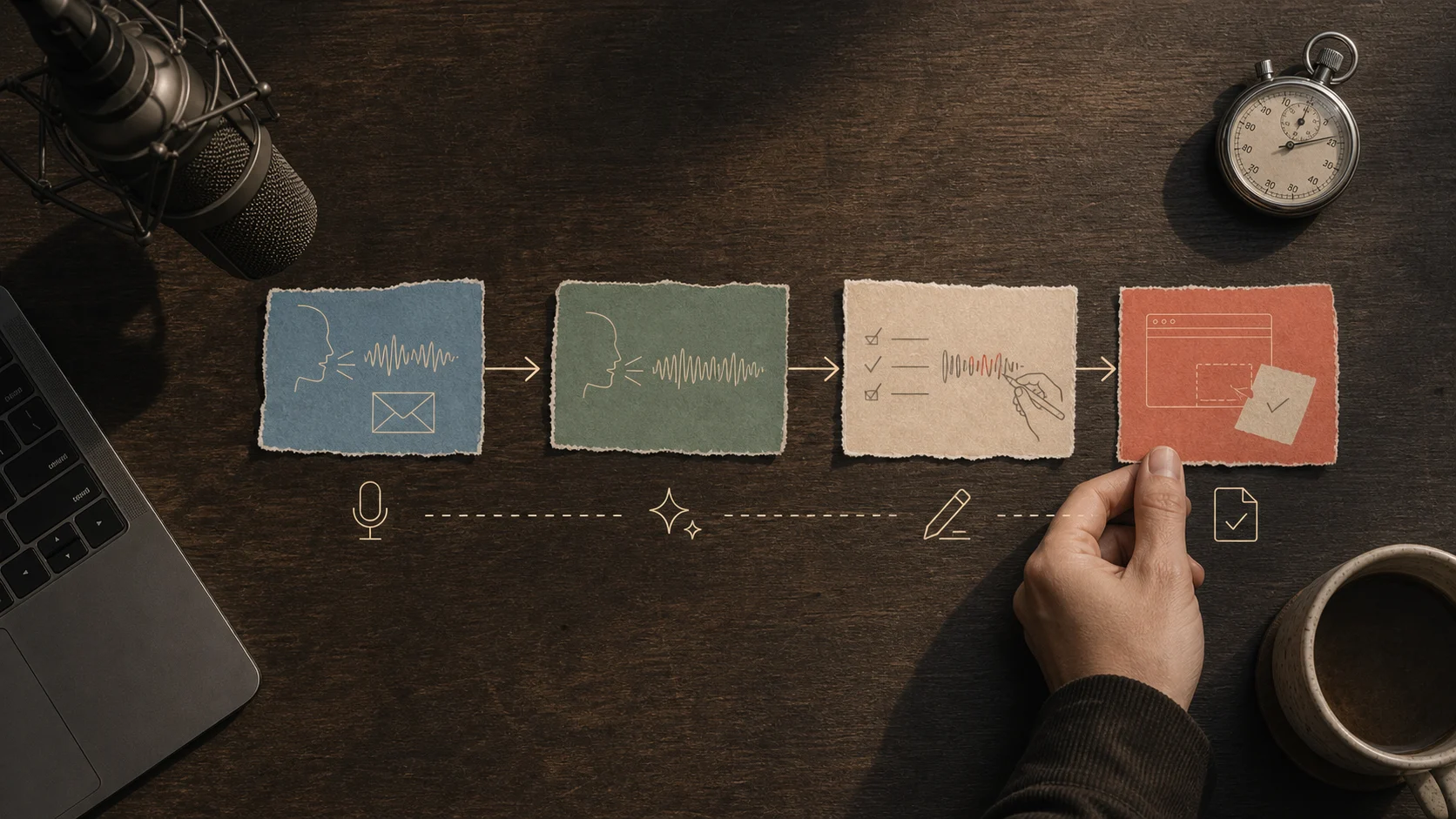
Use the same script for every candidate. After ten minutes, the best fit is usually the tool that creates the least friction for your actual destination—not the one with the longest feature list.
Questions people ask about Mac dictation
Does a Mac have built-in speech-to-text?
Yes. macOS includes Dictation for entering text and Voice Control for a broader hands-free interface. They are separate modes and cannot be used at the same time.
What is the best free dictation software for Mac?
Apple Dictation is the most practical free starting point because it is already installed. Dedicated tools may also offer free plans, but those often limit usage or reserve advanced workflows for paid tiers.
Can Mac dictation work offline?
Sometimes. Apple tells users to inspect Keyboard settings for the processing behavior of their Mac and language. Superwhisper and MacWhisper provide local-model options, but selected models and optional cloud features matter. Verify the exact mode instead of relying on a product-level label.
Is dictation software suitable for medical or legal work?
General-purpose dictation should not be assumed to meet clinical, legal, confidentiality, retention, or organizational requirements. This guide does not evaluate medical dictation systems or certify any tool for regulated work. Use purpose-built procurement and compliance review for those cases.
Should I use dictation or a meeting transcriber?
Use dictation to compose text while you are working. Use a meeting or file transcriber when the source is an existing conversation or recording and you need a durable transcript, speaker structure, playback, or exports.
The useful question is not “Which app recognizes speech?” Most of them do. Ask which one moves your voice into the right form, in the right place, with a processing path you can accept.